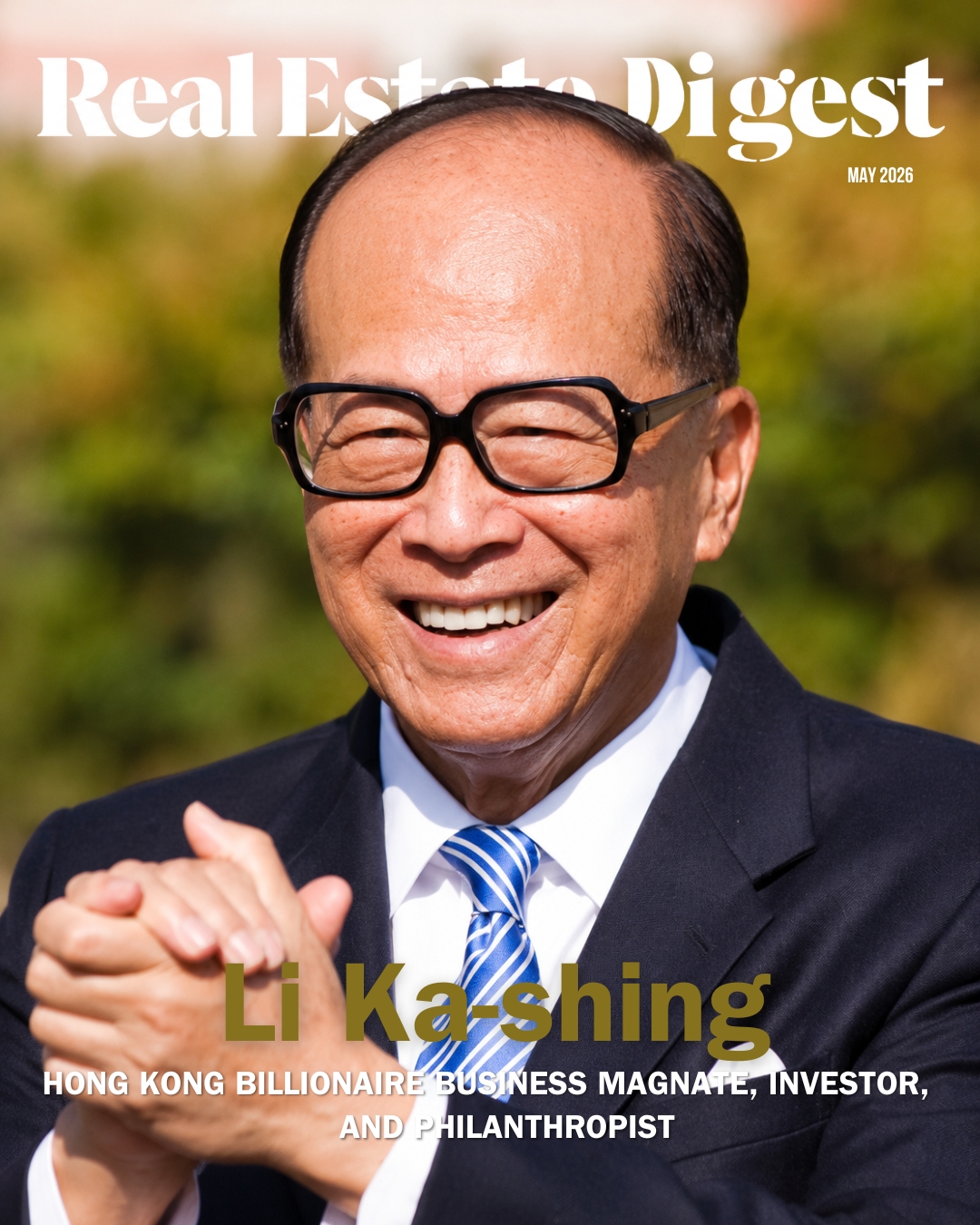
Few business leaders have shaped modern Asian real estate as profoundly as Li Ka Shing. Over the course of several decades, the Hong Kong billionaire transformed a modest plastics business into one of the world’s largest property and infrastructure empires. While many know Li Ka Shing as a global investor and billionaire entrepreneur, real estate formed the foundation of his extraordinary success.
Through companies such as CK Asset Holdings and Cheung Kong Holdings, Li helped redefine Hong Kong’s skyline while building a property portfolio that stretched far beyond Asia. His developments reshaped urban districts, influenced regional housing markets, and established new standards for large scale real estate investment.
In Hong Kong, where land scarcity drives intense competition and enormous property values, Li Ka Shing emerged as one of the most powerful developers of his era. His ability to identify undervalued land, navigate economic cycles, and pursue long term investments turned him into one of the most influential real estate figures in modern business history.
Early Life of Li Ka Shing
Li Ka Shing was born in 1928 in Chaozhou, Guangdong Province, China. His family moved to Hong Kong during the turbulence of the Second Sino Japanese War. Like many immigrant families at the time, they faced financial hardship.
After his father died from tuberculosis, Li left school at a young age to support his family. He worked long hours in factories and learned the realities of business early in life. Those experiences shaped his disciplined work ethic and cautious investment philosophy.
In 1950, Li founded Cheung Kong Industries, initially producing plastic flowers and other plastic goods. The business succeeded quickly as demand for affordable manufactured products grew internationally.
Yet Li understood something important about Hong Kong’s future. Manufacturing would create wealth, but land would create lasting power.
Entering the Hong Kong Real Estate Market
During the 1950s and 1960s, Hong Kong experienced rapid urbanization and population growth. Refugees and migrants from mainland China increased demand for housing and commercial space. At the same time, industrial growth accelerated the city’s economic transformation.
Li recognized that Hong Kong’s limited supply of developable land would eventually become one of the world’s most valuable assets.
In the 1960s, political unrest and riots shook Hong Kong’s economy. Property prices declined sharply as uncertainty spread through financial markets. Many investors retreated. Li Ka Shing moved in the opposite direction.
He began purchasing land and real estate aggressively while prices remained depressed. This strategy would become one of the defining moments of his career.
Rather than viewing the downturn as a crisis, Li viewed it as an opportunity to secure long term assets at discounted values. That disciplined approach laid the foundation for his future real estate empire.
The Rise of Cheung Kong Holdings
In 1971, Li Ka Shing formally established Cheung Kong Holdings as a real estate development company.
The timing aligned perfectly with Hong Kong’s economic expansion during the 1970s. Rising incomes, population growth, and financial development fueled intense demand for residential and commercial property.
Cheung Kong quickly became one of Hong Kong’s leading developers. The company focused on residential projects, office towers, mixed use developments, and strategic land acquisition.
Li distinguished himself through patience and timing. He did not simply chase rapid expansion. He acquired land carefully, developed projects strategically, and maintained strong financial discipline.
One of Li’s most significant business moves came in 1979 when Cheung Kong acquired a controlling stake in Hutchison Whampoa. At the time, Hutchison was one of Hong Kong’s oldest British trading companies.
The acquisition marked a turning point in Hong Kong business history. Li became the first Chinese entrepreneur to control one of the major British trading houses that had long dominated the city’s economy.
This deal dramatically expanded his influence across property, infrastructure, ports, telecommunications, and retail.
Li Ka Shing’s Real Estate Strategy
Li Ka Shing built his property empire through several core principles.
First, he understood the long term value of prime urban land. In densely populated cities such as Hong Kong, land scarcity drives sustained property appreciation over time. Li focused heavily on acquiring strategic sites in high demand locations.
Second, he maintained strong liquidity and financial flexibility. During economic downturns, many competitors struggled under heavy debt loads. Li often used those moments to acquire valuable assets at favorable prices.
Third, he diversified across property sectors. Cheung Kong and later CK Asset expanded into residential housing, office buildings, hotels, shopping centers, serviced apartments, and mixed use developments.
This diversification helped stabilize revenue streams during market volatility.
Finally, Li embraced global expansion. While Hong Kong remained central to his empire, he recognized the importance of international property investment long before many competitors pursued overseas markets.
Reshaping Hong Kong’s Skyline
Li Ka Shing played a major role in transforming Hong Kong into one of the world’s most recognizable urban skylines.
His companies developed major residential communities, luxury apartment towers, and office complexes throughout the territory. These projects supported Hong Kong’s emergence as a global financial center.
Cheung Kong Center became one of the company’s most iconic commercial developments. Located in Central, Hong Kong’s primary business district, the skyscraper symbolized Li’s growing influence within the city’s corporate landscape.
The tower attracted multinational corporations, financial institutions, and global firms seeking premium office space in Asia.
Residential development also remained a major focus. Hong Kong’s housing market has long been among the world’s most competitive and expensive. Li’s companies developed large scale residential projects aimed at middle class buyers, affluent investors, and luxury homeowners.
These developments often combined retail, transportation access, and community infrastructure within integrated urban environments.
The Evolution Into CK Asset Holdings
In 2015, Li Ka Shing reorganized his business empire. Cheung Kong Holdings merged with Hutchison Whampoa before splitting into two primary listed companies.
CK Hutchison Holdings focused on infrastructure, ports, retail, and telecommunications. CK Asset Holdings became the core real estate arm of the empire.
This restructuring reflected the growing scale and complexity of Li’s global investments.
CK Asset continued expanding its property portfolio across Hong Kong, mainland China, Europe, and other international markets. The company invested heavily in residential projects, commercial developments, hotels, and rental properties.
The restructuring also positioned Li’s sons to gradually assume greater leadership roles while maintaining the long term strategic direction of the business.
Global Expansion of Li Ka Shing’s Property Empire
Unlike many traditional Hong Kong developers, Li Ka Shing pursued aggressive international diversification.
His companies invested in real estate across mainland China, Singapore, Canada, the United Kingdom, and Australia. London became a particularly important market for CK Asset.
The company acquired office buildings, residential projects, infrastructure assets, and redevelopment sites throughout the United Kingdom. These investments reflected Li’s belief that major global cities would continue attracting capital and population growth over the long term.
This global strategy reduced reliance on Hong Kong’s cyclical property market while expanding access to international opportunities.
Li’s international investments also demonstrated his broader understanding of urban economics. He recognized that cities with strong financial systems, stable legal environments, and limited land supply would likely maintain long term real estate value.
Li Ka Shing’s Influence on Asian Real Estate
Li Ka Shing’s influence extends far beyond individual developments.
He helped shape how Asian developers approached land investment, financial management, and long term urban planning. His disciplined investment style became a model for many entrepreneurs throughout the region.
Business analysts often describe Li as one of the most strategic investors in modern Asian business history. He built wealth not through speculation alone, but through patience, timing, and calculated risk management.
His ability to acquire assets during periods of uncertainty became especially well known. During financial downturns, Li frequently emerged as a buyer while competitors struggled defensively.
That pattern reinforced his reputation as a long term thinker rather than a short term speculator.
Philanthropy and Legacy
Beyond business, Li Ka Shing became one of Asia’s most prominent philanthropists.
Through the Li Ka Shing Foundation, he donated billions of dollars to education, healthcare, scientific research, and humanitarian initiatives around the world.
His philanthropic work supported universities, hospitals, and innovation programs across Hong Kong, mainland China, North America, and Europe.
Li often emphasized education and knowledge as drivers of long term opportunity. His donations reflected a belief that economic growth should support broader social progress.
Even after retiring from day to day leadership in 2018, Li remained deeply respected within global business circles. His business empire continued operating under the next generation of leadership while maintaining many of the principles he established.
The Lasting Impact of Li Ka Shing on Real Estate
Li Ka Shing’s story reflects more than personal wealth accumulation. It mirrors Hong Kong’s rise as a global economic powerhouse and demonstrates the extraordinary influence real estate can have on urban development.
Through CK Asset and its predecessor companies, Li helped shape housing markets, commercial districts, and investment strategies across Asia and beyond.
His projects transformed skylines. His acquisitions reshaped industries. His long term approach influenced generations of investors and developers.
Perhaps most importantly, Li understood something fundamental about real estate. Cities evolve continuously, but prime land in global urban centers remains one of the world’s most enduring assets.
That insight allowed him to build one of the largest real estate fortunes in modern history.
Today, CK Asset Holdings remains one of Asia’s leading property companies, and Li Ka Shing’s legacy continues to influence the global real estate industry. From Hong Kong skyscrapers to international development projects, his impact on urban growth and property investment remains impossible to ignore.
Few developers changed the modern real estate landscape as profoundly as Li Ka Shing.