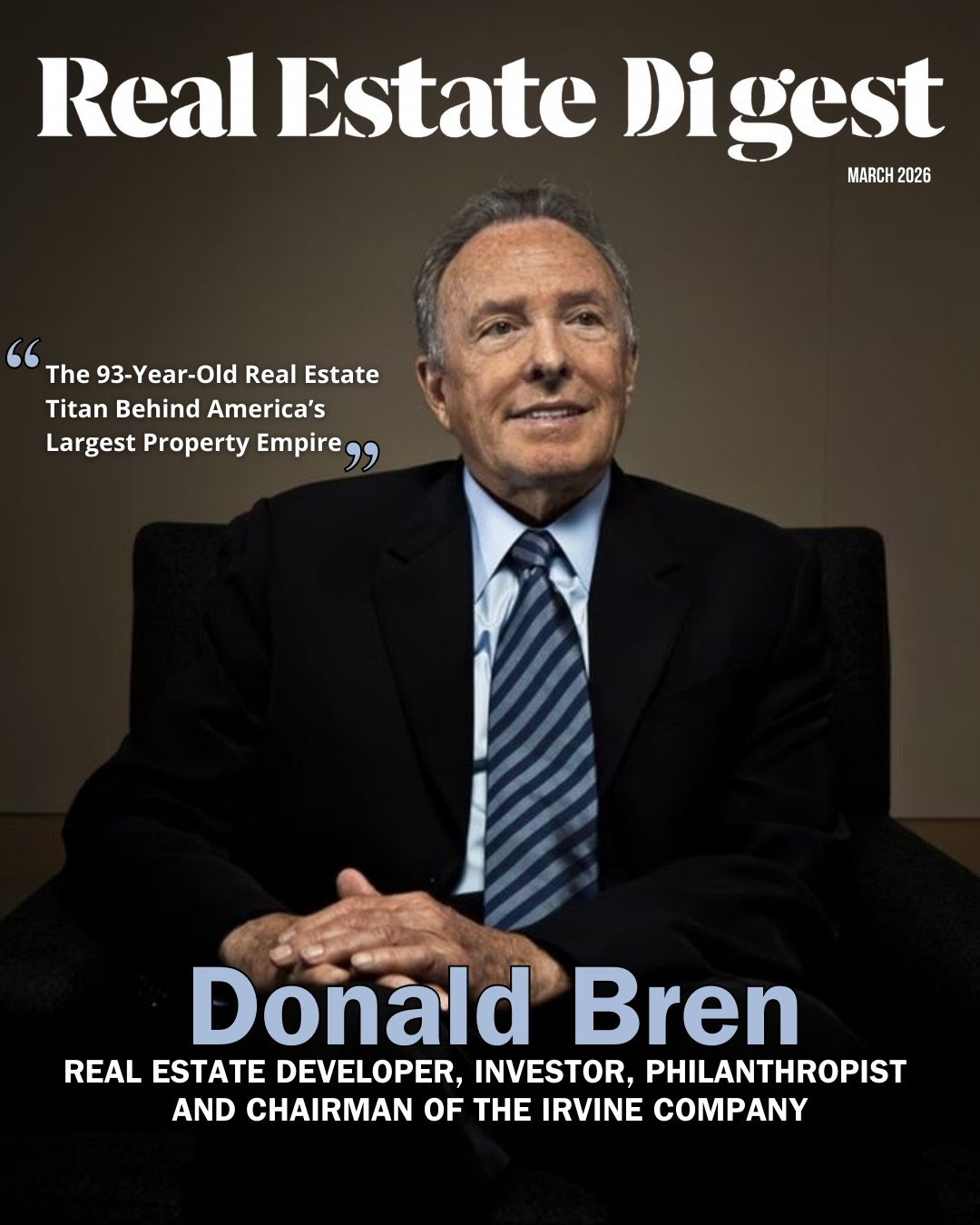
In the vast landscape of American real estate, few figures have shaped a region as profoundly as Donald Bren. Quiet, methodical, and intensely private, Bren has spent decades transforming Southern California’s Orange County into one of the most carefully planned urban environments in the United States. Through his stewardship of The Irvine Company, he has overseen the development of tens of thousands of homes, millions of square feet of office space, and a network of parks, retail centers, and coastal preserves that collectively define modern Irvine.
While many developers chase rapid expansion or headline-grabbing deals, Bren has built his reputation through long-term planning and disciplined land control. His strategy has allowed The Irvine Company to guide growth across a master planned environment that integrates housing, business districts, education, and open space. The result is a development model that has drawn attention from urban planners, economists, and policymakers who seek sustainable approaches to metropolitan growth.
Donald Bren’s story begins with a foundation in engineering and military service. Born in Los Angeles in 1932, Bren studied business administration at the University of Washington before serving as a Marine Corps officer. After leaving the military, he entered the real estate industry during a period of rapid expansion across Southern California. The postwar boom had created enormous demand for housing and infrastructure, and developers were racing to meet the needs of a growing population.
In the 1950s and 1960s, Bren began building homes in Orange County through its Bren Company. His early projects focused on residential communities, and he quickly developed a reputation for disciplined construction and thoughtful planning. He paid close attention to how neighborhoods functioned over time. Streets, parks, schools, and commercial centers had to work together to create livable environments.
That focus on planning would later define his career.
The Irvine Company itself traces its origins to the 19th century. The Irvine Ranch, a massive tract of land covering more than 100,000 acres in Orange County, was once primarily agricultural. For decades, it remained largely undeveloped, even as surrounding regions experienced rapid suburban expansion.
By the mid-twentieth century, the owners of the Irvine Ranch began exploring large-scale development. Instead of dividing the land into smaller projects, they envisioned a comprehensive master planned community that would grow gradually and intentionally.
In 1977, Donald Bren purchased a controlling stake in The Irvine Company and assumed leadership of the enterprise. Over time, he consolidated ownership, eventually becoming the sole owner. That move placed him in charge of one of the largest privately held real estate portfolios in the United States.
Bren did not treat the Irvine Ranch as a collection of individual projects. He treated it as a long-term ecosystem.
Under his leadership, The Irvine Company embraced a master planning strategy that prioritized balance. Residential neighborhoods would sit near schools, parks, and shopping centers. Office complexes would integrate with transportation networks and community infrastructure. Open space would remain protected, even as development expanded.
That strategy helped shape the city of Irvine, which has become one of the most carefully designed municipalities in the country. Wide boulevards, landscaped medians, and integrated bike paths reflect a deliberate approach to urban design. Residential villages cluster around local amenities, while major business districts anchor employment opportunities within the community.
Today, Irvine regularly ranks among the safest cities in the United States. It also maintains strong public schools, well-maintained parks, and an extensive network of community facilities. While many factors contribute to these outcomes, The Irvine Company’s planning philosophy has played a central role.
Bren has often described land stewardship as a responsibility rather than a simple business opportunity. That perspective has guided The Irvine Company’s long-term development approach. Instead of selling land quickly, the company frequently retains ownership and manages properties over decades.
This model allows The Irvine Company to maintain consistent design standards across its communities. It also enables the company to respond to economic cycles without abandoning its long-term vision.
Beyond residential neighborhoods, the company has built a substantial commercial real estate portfolio. The Irvine Company owns and operates millions of square feet of office space throughout Southern California. Its office campuses house technology firms, financial institutions, and professional service companies.
The company’s office properties emphasize campus-style layouts that combine landscaping, open space, and modern architecture. These environments aim to create workplaces that attract top talent while supporting productivity and collaboration.
Retail development also forms a major component of The Irvine Company’s portfolio. The firm owns several prominent shopping centers across Orange County, including large-scale lifestyle destinations that combine retail, dining, and entertainment.
Rather than focusing solely on traditional malls, The Irvine Company has invested heavily in open-air retail environments that emphasize pedestrian-friendly design. These centers often include landscaped plazas, outdoor seating areas, and event spaces that encourage community engagement.
In addition to commercial and residential development, Bren has made environmental preservation a key part of the company’s identity.
Large portions of the original Irvine Ranch remain protected as open space. Over the years, Bren and The Irvine Company have worked with conservation groups and government agencies to preserve thousands of acres of land for public use.
These preserved areas include coastal habitats, wilderness parks, and scenic trails that stretch across Orange County’s natural landscapes. The Irvine Ranch Natural Landmarks initiative has helped protect ecosystems while providing residents with access to outdoor recreation.
Bren has also directed significant philanthropic contributions toward education and environmental causes. In 2007, he donated $ 20 million to the University of California, Irvine, School of Information and Computer Sciences. The school now bears his name.
His philanthropic work has supported parks, conservation programs, and academic institutions throughout California. Bren has consistently emphasized the importance of education and environmental stewardship as foundations for long-term community success.
Despite his influence, Donald Bren maintains a remarkably low public profile. Unlike many high-profile developers, he rarely appears in interviews or public events. He prefers to let his work speak for itself.
Industry observers often describe him as meticulous and strategic. He carefully studies land-use patterns and prioritizes long-term stability over rapid expansion. This approach has helped The Irvine Company weather economic downturns that have disrupted many real estate firms.
The company’s financial strength also reflects Bren’s disciplined management style. Because The Irvine Company remains privately held, it does not face the same pressures as publicly traded real estate corporations. Bren can pursue long-term investments without the short-term demands of quarterly earnings reports.
This independence has allowed the company to maintain a consistent vision across decades of development.
At the same time, Bren’s influence extends beyond Orange County. The Irvine Company owns office properties and apartment communities in several major markets, including San Diego, Los Angeles, Silicon Valley, Chicago, and New York.
Its residential division manages thousands of apartment homes designed with resort style amenities and landscaped environments. These communities emphasize walkability, green spaces, and modern architectural design.
The company’s expansion into other markets demonstrates how its planning philosophy can adapt to different urban environments. Yet Orange County remains the heart of Bren’s legacy.
The transformation of the Irvine Ranch stands as one of the most significant examples of master planned development in modern American history. Instead of allowing fragmented growth to reshape the land, Bren and The Irvine Company pursued a unified strategy that balanced economic development with environmental preservation.
Urban planners frequently study Irvine as a model for coordinated land use. The city’s layout reflects decades of careful planning rather than piecemeal construction. Residential villages, employment centers, and recreational spaces function as parts of a larger system.
This model contrasts sharply with many American suburbs, where rapid expansion often produces disconnected neighborhoods and limited infrastructure.
Bren’s approach has also influenced how developers think about long-term land ownership. By retaining control of large land parcels, The Irvine Company can guide development over generations. That level of continuity rarely exists in regions where property changes hands frequently.
The company’s strategy does not come without criticism. Some observers argue that centralized planning can limit architectural diversity or raise housing costs in high-demand communities. Others question whether private developers should wield such significant influence over regional growth.
Yet even critics acknowledge the scale of Bren’s impact. Few developers have shaped an entire metropolitan region with such consistency and long-term perspective.
Donald Bren now ranks among the wealthiest real estate owners in the United States. Forbes has frequently listed him among the richest individuals in America. Despite that wealth, he maintains the same understated presence that has defined his career.
His focus remains fixed on land stewardship and responsible development. The Irvine Company continues to manage communities that reflect decades of planning and investment.
As Southern California faces new challenges related to housing affordability, environmental sustainability, and urban growth, Bren’s legacy offers an important case study. His work demonstrates how careful planning, patient investment, and environmental awareness can guide development across generations.
In the real estate industry, often driven by short-term speculation, Donald Bren represents a different model. He built a company that prioritizes long-term vision over quick returns. He shaped communities that integrate housing, business, education, and open space.
And through The Irvine Company, he transformed a historic ranch into one of the most influential master planned regions in the United States.
For residents of Irvine and the surrounding areas, the results of that vision appear every day in the parks, schools, neighborhoods, and business districts that define the region.
Donald Bren may avoid the spotlight, but the communities he helped create stand as enduring evidence of his impact on the modern American landscape.